Poets Directory (شعرائے کرام)
Explore profiles, portraits, life biographies, and complete poetry of classical and modern Urdu luminaries.
Ghawwasi
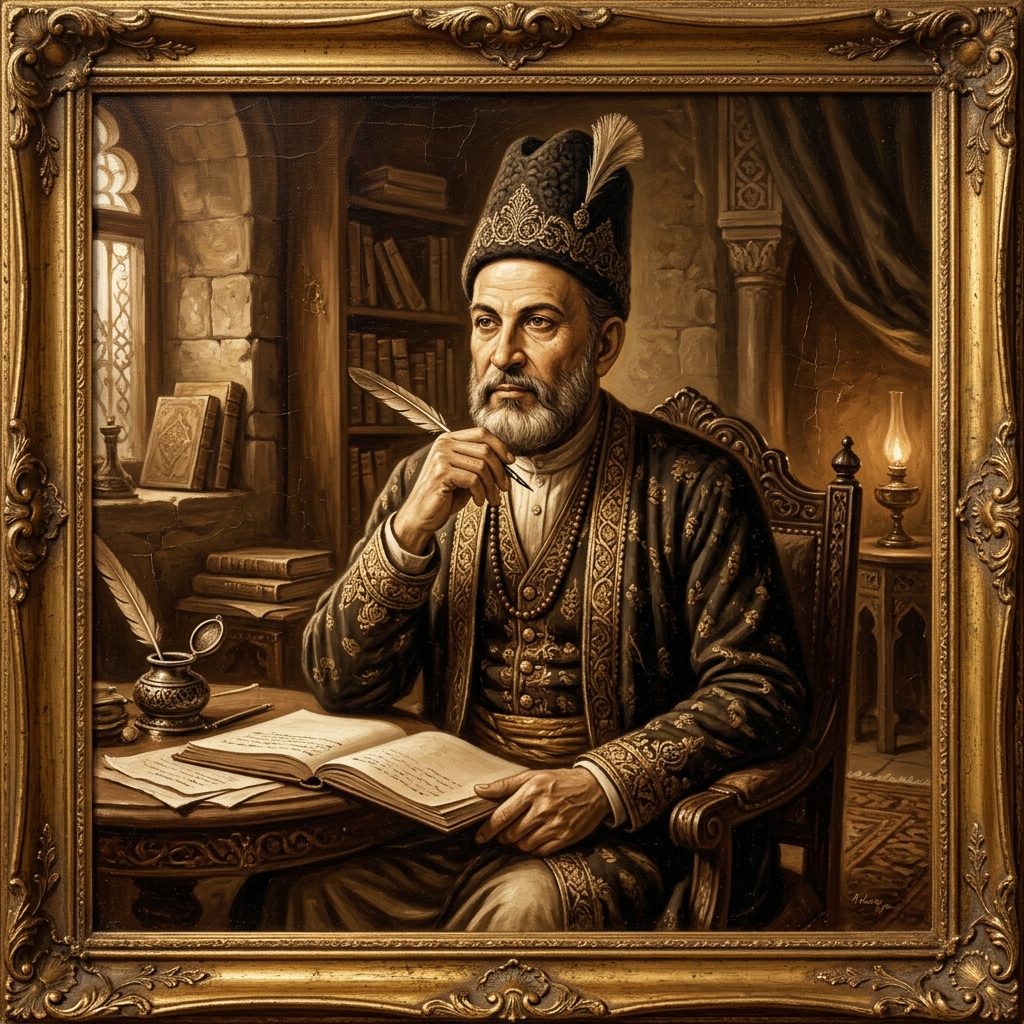
Ghawwasi was a seventeenth-century Dakhni poet of the Deccan, also known as Gawwasi Bedri and in literary histories as Mulla Ghawwasi, court poet of Golconda under Sultan Abdullah Qutb Shah. His fame rests on the romance masnavi Saif al-Muluk wa Badi' al-Jamal — the tale of Prince Saif al-Muluk and Badi' al-Jamal — begun under Muhammad Quli Qutb Shah and completed in 1035 AH (1625–26), in over two thousand verses; literary histories also credit him with a Tutinama. As a court poet he was trusted enough to be sent as an envoy to Bijapur in 1045 AH, when the Adil Shahi court sent its own envoy to Golconda. His surviving ghazals, in plain Dakhni, turn on the saqi's cup, the beloved who is the heart's comfort, and a proud final claim: that no one has grasped Ghawwasi's manner. The takhallus itself — the diver — suits a poet of romance, descending for pearls.
Ghulam Ali Azad Bilgrami
Mir Ghulam Ali Azad Bilgrami (1704–1786) was born at Bilgram, in Awadh, into a family of scholars, and became one of the great learned men of eighteenth-century India — a poet in Arabic and Persian, a biographer of poets, and a historian of his own town and age. Taught first by his grandfather, the scholar-poet Mir Abdul Jalil Bilgrami, he travelled widely in his youth — Delhi, Lahore, Multan, Sind — and in 1737 set out for the Hijaz, where he spent two years studying the traditions of the Prophet in Mecca and Medina. On his return he settled at Aurangabad in the Deccan, where he lived the rest of his long life, its first seven years in seclusion at a saint's tomb, refusing court service and reserving his praise-poetry for the Prophet and the saints — the devotion that earned him the title Hassan of Hind, the Hassan of India. His Arabic diwan alone contains more than three thousand couplets, and beside it stand a Persian diwan and long masnavis; but his lasting gift to literature is his biographical writing. In three great Persian dictionaries of poets — Yad-e-Bayza, with lives of 532 poets; Sarv-e-Azad, with 143 poets of India, among them eight early Urdu poets; and Khizana-e-Amira, written in 1762–63, with 135 poets — he preserved the lives and verses of men he often knew himself, and in Ma'asir al-Kiram he wrote the history of Bilgram, its saints and learned men. His Subhat al-Marjan, the Coral Rosary, written in Arabic in 1763–64, wove together Indian and Arabic learning and praised India as the first home of Adam. He died at Aurangabad in 1786, aged eighty-two, and was buried at Khuldabad, near the shrine of Amir Hasan Dihlavi.
Ghulam Hamdani Mushafi
The witty chronicler-poet of old Delhi and Lucknow, whose maqtas still sting and heal.
Ghulam Muhammad Qasir
Ghulam Muhammad Qasir (d. 1999) was a Pakistani Urdu poet from Paharpur, Dera Ismail Khan, counted among the finest modern poets of the Urdu ghazal. A Pashtun who grew up speaking Pashto, he made Urdu his literary home. Ahmad Nadeem Qasmi introduced him in the journal Fanoon in 1977, the year his first collection Tasalsul appeared; Qasmi called him "the poet of continuity". Two further collections followed — Aathwaan Aasman Bhi Neela Hai (1988) and Darya-e-Gumaan (1997) — and his complete works were gathered as Ik Sher Abhi Tak Rehta Hai. By profession a lecturer in Urdu at government colleges across the North-West Frontier Province, he also wrote more than seventy dramas and programmes for PTV Peshawar and Radio Pakistan, including the popular serials Talash and Bhoot Bangla. His ghazal turns away from the beloved alone toward the deprivation and hope of ordinary people — a book instead of gunpowder, a dream instead of despair. He died in Peshawar on 20 February 1999 and is buried there; the Government of Pakistan awarded him the Pride of Performance posthumously in 2006–07.
Gulzar Dehlvi
Gulzar Dehlvi (1926–2020), born Anand Mohan Zutshi, was one of the last voices of Old Delhi's composite Ganga-Jamuni culture — a Kashmiri Pandit who carried the Gita and the Quran in one heart, and wrote Urdu ghazals in a white sherwani with a rose on his chest. Born on 7 July 1926 in Gali Kashmeerian, Old Delhi, to two poets — his father Tribhuvan Nath 'Zar' and his mother Brij Rani 'Be-Zaar' — he was given his pen name 'Gulzar', a bed of roses, by his ustad Bekhud Dehlvi. He took an M.A. from Hindu College, Delhi, and became editor-in-chief of Science Ki Duniya in 1975, Urdu's first science magazine. Jawaharlal Nehru recited his poem 'Zarurat Hai Un Naujawano Ki' from the Red Fort on 15 August 1947. Honoured by the Vice-President of India on his 91st birthday for his lifelong service to Urdu, he died at his Noida home on 12 June 2020, days after recovering from COVID-19, aged 93.