
Poets Directory (شعرائے کرام)
Explore profiles, portraits, life biographies, and complete poetry of classical and modern Urdu luminaries.
Qayem Chandpuri
Qayem Chandpuri (1722–1793), born Sheikh Qayam-ud-din at Chandpur in Bijnor district, was one of the prominent poets of the eighteenth-century Delhi school — the contemporary, and the self-declared rival, of Mir Taqi Mir, Mirza Sauda and Khwaja Mir Dard. He began as a disciple of Mir Dard and then of Mir himself, but made his own road: a plain, simple, idiomatic rekhta, stripped of ornament, that claimed dignity for the spoken tongue. Delhi in his lifetime was a city of invasions and upheaval — he wrote shahr-ashobs on the turmoil of Shah Alam II's Delhi — and his long years at Rampur, and a spell at Lucknow under Raja Ticket Roy's patronage, gave him the full canvas of the declining Mughal world. Alongside the divan, he left a prose tazkira, Tazkira-e-Makhzan-e-Nikaat, keeping the record of his age's poets. His famous boast — that he gave rekhta itself "the robe of acceptance" — is the claim of a whole school: that Urdu, the plain tongue, needs no apology before any master.
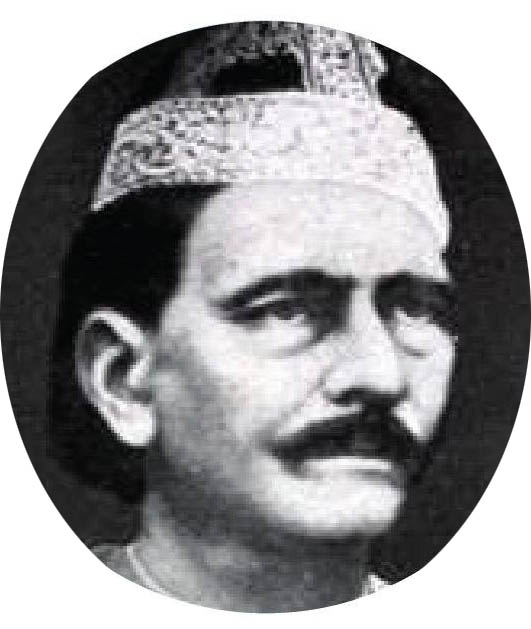
Qalandar Bakhsh Jur'at
Yahya Aman, known to poetry as Qalandar Bakhsh Jur'at (1748–1809), was the Lucknow school's most exuberant voice. Born in Delhi and raised in Faizabad, he settled in Lucknow, where he entered the service of Mirza Sulaiman Shikoh and became a beloved fixture of the nobility's gatherings with his wit, humour and mischievous storytelling. A disciple of Mirza Ja'far Ali Hasrat and the lifelong friend of Insha Allah Khan 'Insha', Jur'at lost his eyesight in the prime of his youth — yet no other poet, blind or sighted, ever painted the colours of love as he did. Mir Taqi Mir called him a "skirt-chasing poet"; his ghazals depict romantic encounters with unabashed sensuality, though some of his verses also carry the melancholy of the political chaos around him. His *Kulliyaat-e-Jurat* appeared in print in 1968. He died in Lucknow in 1809.