
Poets Directory (شعرائے کرام)
Explore profiles, portraits, life biographies, and complete poetry of classical and modern Urdu luminaries.
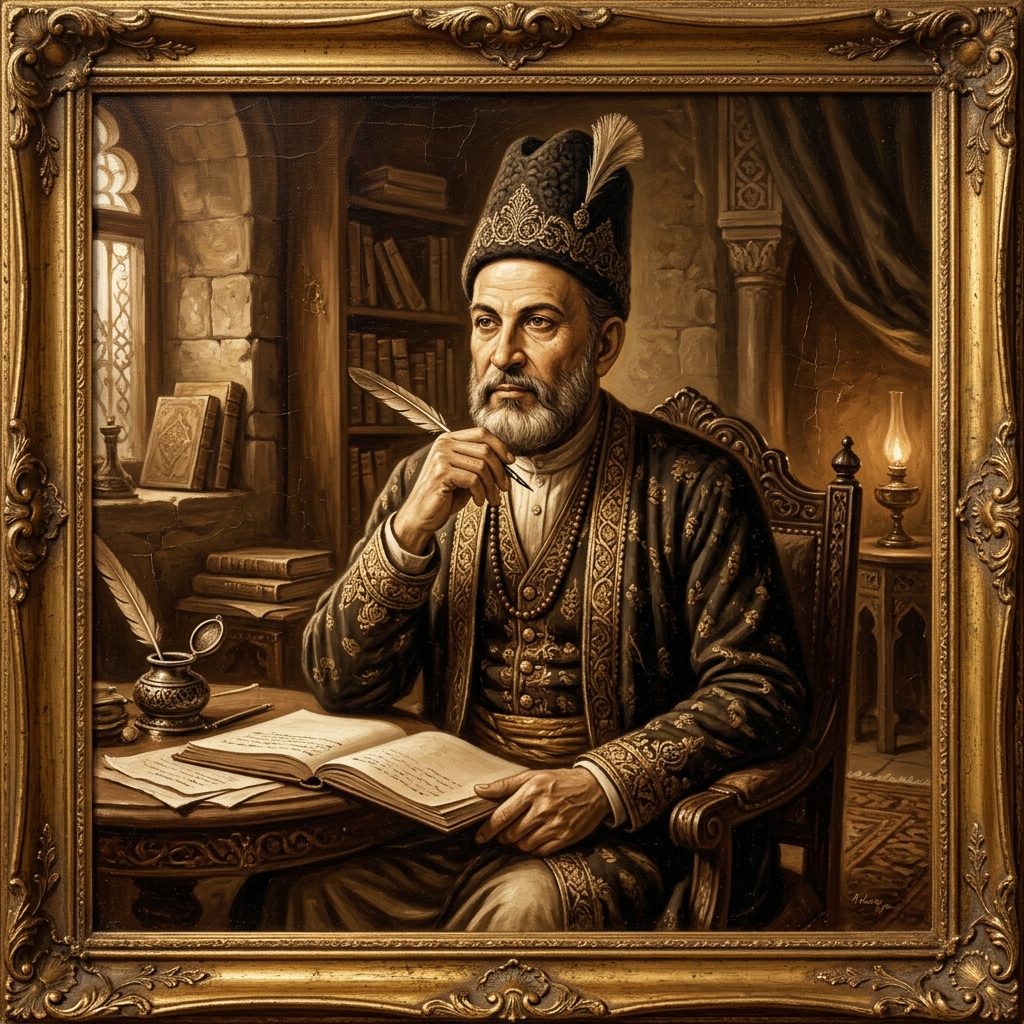
Ghawwasi
Ghawwasi was a seventeenth-century Dakhni poet of the Deccan, also known as Gawwasi Bedri and in literary histories as Mulla Ghawwasi, court poet of Golconda under Sultan Abdullah Qutb Shah. His fame rests on the romance masnavi Saif al-Muluk wa Badi' al-Jamal — the tale of Prince Saif al-Muluk and Badi' al-Jamal — begun under Muhammad Quli Qutb Shah and completed in 1035 AH (1625–26), in over two thousand verses; literary histories also credit him with a Tutinama. As a court poet he was trusted enough to be sent as an envoy to Bijapur in 1045 AH, when the Adil Shahi court sent its own envoy to Golconda. His surviving ghazals, in plain Dakhni, turn on the saqi's cup, the beloved who is the heart's comfort, and a proud final claim: that no one has grasped Ghawwasi's manner. The takhallus itself — the diver — suits a poet of romance, descending for pearls.
Ghulam Ali Azad Bilgrami
Mir Ghulam Ali Azad Bilgrami (1704–1786) was born at Bilgram, in Awadh, into a family of scholars, and became one of the great learned men of eighteenth-century India — a poet in Arabic and Persian, a biographer of poets, and a historian of his own town and age. Taught first by his grandfather, the scholar-poet Mir Abdul Jalil Bilgrami, he travelled widely in his youth — Delhi, Lahore, Multan, Sind — and in 1737 set out for the Hijaz, where he spent two years studying the traditions of the Prophet in Mecca and Medina. On his return he settled at Aurangabad in the Deccan, where he lived the rest of his long life, its first seven years in seclusion at a saint's tomb, refusing court service and reserving his praise-poetry for the Prophet and the saints — the devotion that earned him the title Hassan of Hind, the Hassan of India. His Arabic diwan alone contains more than three thousand couplets, and beside it stand a Persian diwan and long masnavis; but his lasting gift to literature is his biographical writing. In three great Persian dictionaries of poets — Yad-e-Bayza, with lives of 532 poets; Sarv-e-Azad, with 143 poets of India, among them eight early Urdu poets; and Khizana-e-Amira, written in 1762–63, with 135 poets — he preserved the lives and verses of men he often knew himself, and in Ma'asir al-Kiram he wrote the history of Bilgram, its saints and learned men. His Subhat al-Marjan, the Coral Rosary, written in Arabic in 1763–64, wove together Indian and Arabic learning and praised India as the first home of Adam. He died at Aurangabad in 1786, aged eighty-two, and was buried at Khuldabad, near the shrine of Amir Hasan Dihlavi.
Ghulam Hamdani Mushafi
The witty chronicler-poet of old Delhi and Lucknow, whose maqtas still sting and heal.